
NJ Sheriff Sales: How They Work & How to Stop One (2026)

Sheriff Sales in New Jersey
NJ Sheriff Sales: How They Work, How to Stop One, and What Happens Next
Last fact-checked: August 12, 2026
If your home has been scheduled for a sheriff sale in New Jersey, time matters.
A sheriff sale normally occurs near the end of the New Jersey mortgage foreclosure process, after the lender has obtained a final judgment and a writ of execution authorizing the property to be sold. The county sheriff then conducts a public auction of the property.
But a scheduled sheriff sale does not necessarily mean you have run out of options.
Depending on how much time remains before the auction, you may still be able to postpone the sale, resolve the mortgage default, complete a loan modification, sell the property, ask a court to stay the sale, or explore bankruptcy with a qualified attorney.
And if the sheriff sale already happened, there are still extremely important deadlines you need to understand.
Quick answer: In New Jersey, the sheriff generally has 150 days after receiving the writ of execution to conduct the foreclosure auction. A homeowner can request two statutory adjournments of up to 30 calendar days each. New Jersey also generally provides a 10-day period following the sheriff sale during which redemption and objections to the sale can become critically important.
This guide explains what a New Jersey sheriff sale is, how the process works, how a sale may be stopped or postponed, what happens to your equity, and what happens after the auction.
Important: This article provides general educational information and is not legal advice. Foreclosure deadlines and individual circumstances vary. If a sheriff sale is imminent or has already occurred, consider contacting a qualified New Jersey foreclosure or bankruptcy attorney immediately.
What Is a Sheriff Sale in New Jersey?
A sheriff sale is a court-authorized public auction of real estate conducted near the end of a judicial foreclosure proceeding.
New Jersey is a judicial foreclosure state. That means a mortgage lender generally cannot simply take ownership of a house because the homeowner stopped making payments. The lender has to use the court system and obtain a foreclosure judgment.
Once the lender obtains a final judgment of foreclosure, a writ of execution can be issued directing the county sheriff to sell the property.
The New Jersey Courts describe the sheriff sale as part of the final stages of the foreclosure process and state that the sheriff generally has 150 days from receipt of the writ of execution to auction the property. See the New Jersey Courts foreclosure resources.
Sheriff Sale vs. Foreclosure: What Is the Difference?
The two terms are related, but they do not mean exactly the same thing.
Foreclosure is the larger legal process the lender uses to enforce its mortgage and recover the property after a default.
A sheriff sale is the auction that generally occurs near the end of that foreclosure process.
A homeowner may therefore be “in foreclosure” for many months before a sheriff sale is actually scheduled.
That distinction matters because homeowners usually have substantially more options earlier in the foreclosure process than they do when the sale is only days away.
How Does the Foreclosure and Sheriff Sale Process Work in NJ?
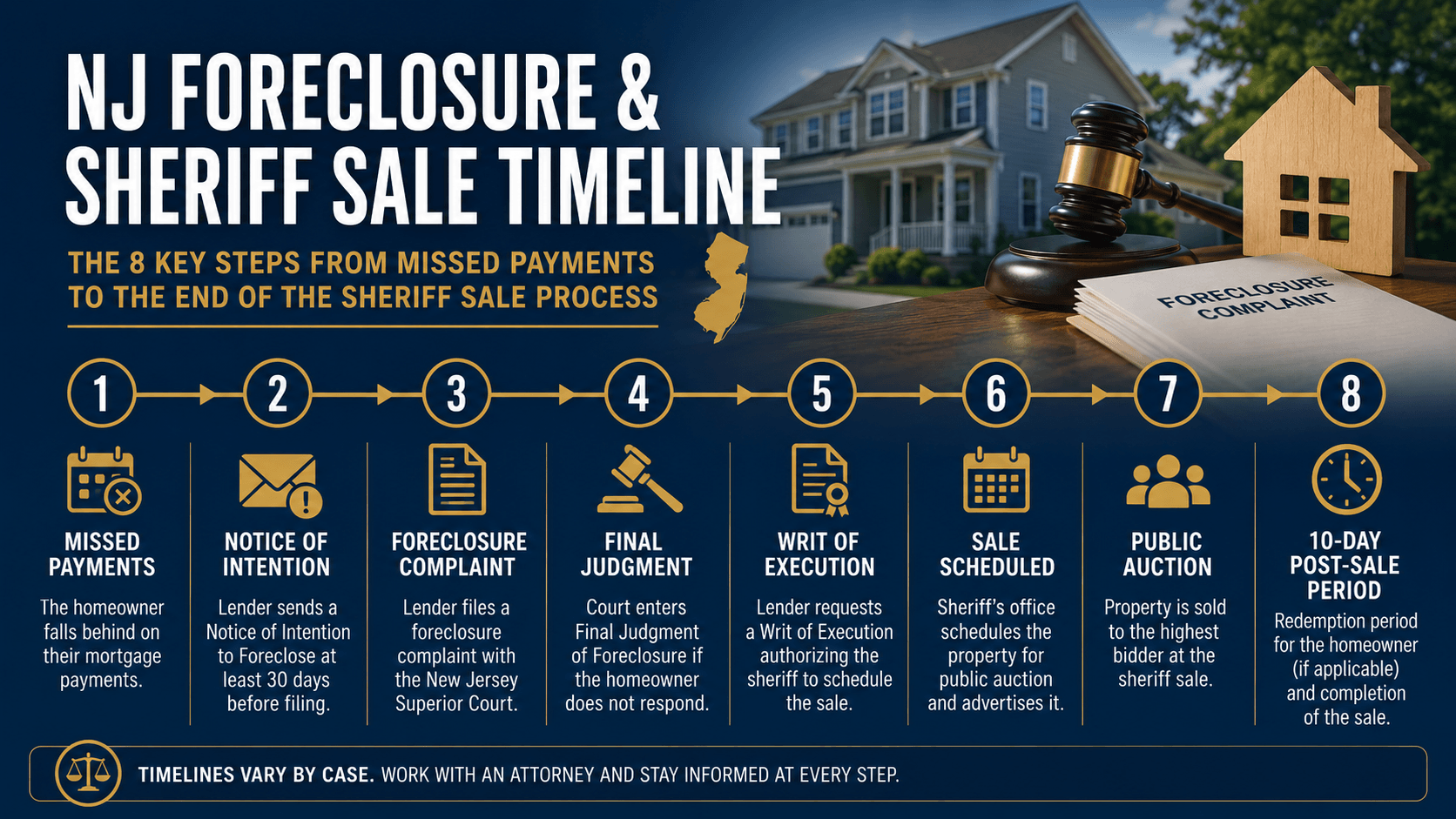
Although every foreclosure is different, a residential mortgage foreclosure in New Jersey generally moves through several major stages.
1. The Mortgage Becomes Delinquent
The process normally begins after the homeowner falls behind on mortgage payments.
A missed payment does not mean the house will immediately go to sheriff sale. There are notices, servicing requirements and a judicial foreclosure process that generally occur first.
2. The Lender Sends a Notice of Intention to Foreclose
For covered residential mortgages, New Jersey’s Fair Foreclosure Act generally requires the lender to send a Notice of Intention to Foreclose before beginning the foreclosure lawsuit.
The New Jersey Department of Community Affairs explains that this notice generally must be provided at least 30 days before the lender begins foreclosure proceedings. See the New Jersey foreclosure resources.
Homeowners should not ignore this letter.
The period before a foreclosure complaint is filed may provide valuable time to communicate with the mortgage servicer, investigate loss-mitigation options and understand the amount necessary to cure the default.
3. The Lender Files a Foreclosure Complaint
If the default is not resolved, the lender can file a foreclosure action in the New Jersey Superior Court.
The homeowner and other parties with an interest in the property may be named as defendants.
This is another major point where taking action early matters.
Waiting until a sheriff sale date appears can turn options that once involved months of planning into decisions that must be made in days.
4. The Lender Obtains Final Judgment
If the foreclosure proceeds, the lender may eventually obtain a final judgment establishing the amount due and authorizing enforcement against the property.
5. A Writ of Execution Is Sent to the Sheriff
After judgment, a writ of execution directs the appropriate county sheriff to sell the property.
Under current New Jersey guidance, the sheriff generally has 150 days from receipt of the writ of execution to conduct the auction. See the New Jersey Courts foreclosure self-help page.
6. The Sheriff Sale Is Scheduled and Advertised
The county sheriff schedules the property for public auction and publishes the required sale information.
Procedures differ somewhat by county, so homeowners should verify the sale date directly with the sheriff’s office in the county where the property is located.
Do not assume a date changed simply because someone told you it might change.
Verify it.
7. The Property Is Auctioned
At the sheriff sale, qualified bidders can bid on the property.
The lender can also bid. If outside bidders do not bid high enough, the foreclosing lender may ultimately become the successful bidder.
8. A Short but Extremely Important Post-Sale Period Begins
New Jersey generally recognizes a 10-day period following the sheriff sale during which the homeowner’s redemption rights and objections to the sale can be critically important.
Morris County, for example, specifically identifies the tenth day following the auction as the end of the defendant’s redemption period. See the Morris County Sheriff’s information on sheriff sales.
A homeowner whose property has already been sold should treat this as an emergency rather than assuming there is plenty of time because a sheriff’s deed has not yet been delivered.
foreclosure and sheriff sale timeline
How Much Time Do You Have Before a Sheriff Sale in NJ?
There is no single answer because the foreclosure process can take different amounts of time.
However, once the writ of execution reaches the sheriff, New Jersey Courts states that the sheriff has 150 days to auction the property.
More important than the overall foreclosure timeline is your actual scheduled sheriff sale date.
Your options look very different depending on whether the sale is:
| Time Remaining | Issues to Investigate Immediately |
|---|---|
| More than 60 days away | Loan modification/loss mitigation, reinstatement, refinance if possible, conventional property sale, legal defenses |
| 38–60 days away | Complete loss-mitigation application, sale of property, statutory adjournment planning, attorney review |
| 1–37 days away | Statutory adjournment, payoff or sale, emergent court relief, bankruptcy consultation if appropriate |
| Sale already occurred | Redemption rights, objection deadline, immediate attorney review, surplus funds and possession issues |
These are not guarantees or legal deadlines for every remedy. They are a practical way of understanding why acting earlier creates more choices.
One particularly important federal threshold involves mortgage loss mitigation. The Consumer Financial Protection Bureau advises borrowers to make sure the servicer receives a complete loss-mitigation application more than 37 days before a scheduled foreclosure sale because important federal servicing protections may apply.
See the Consumer Financial Protection Bureau’s mortgage servicing rules.
ways to stop postpone a sheriff sale
How Can You Stop a Sheriff Sale in New Jersey?
A sheriff sale can sometimes be stopped, postponed or avoided, but the appropriate solution depends heavily on the facts and how much time remains.
There is no single “stop foreclosure” button.
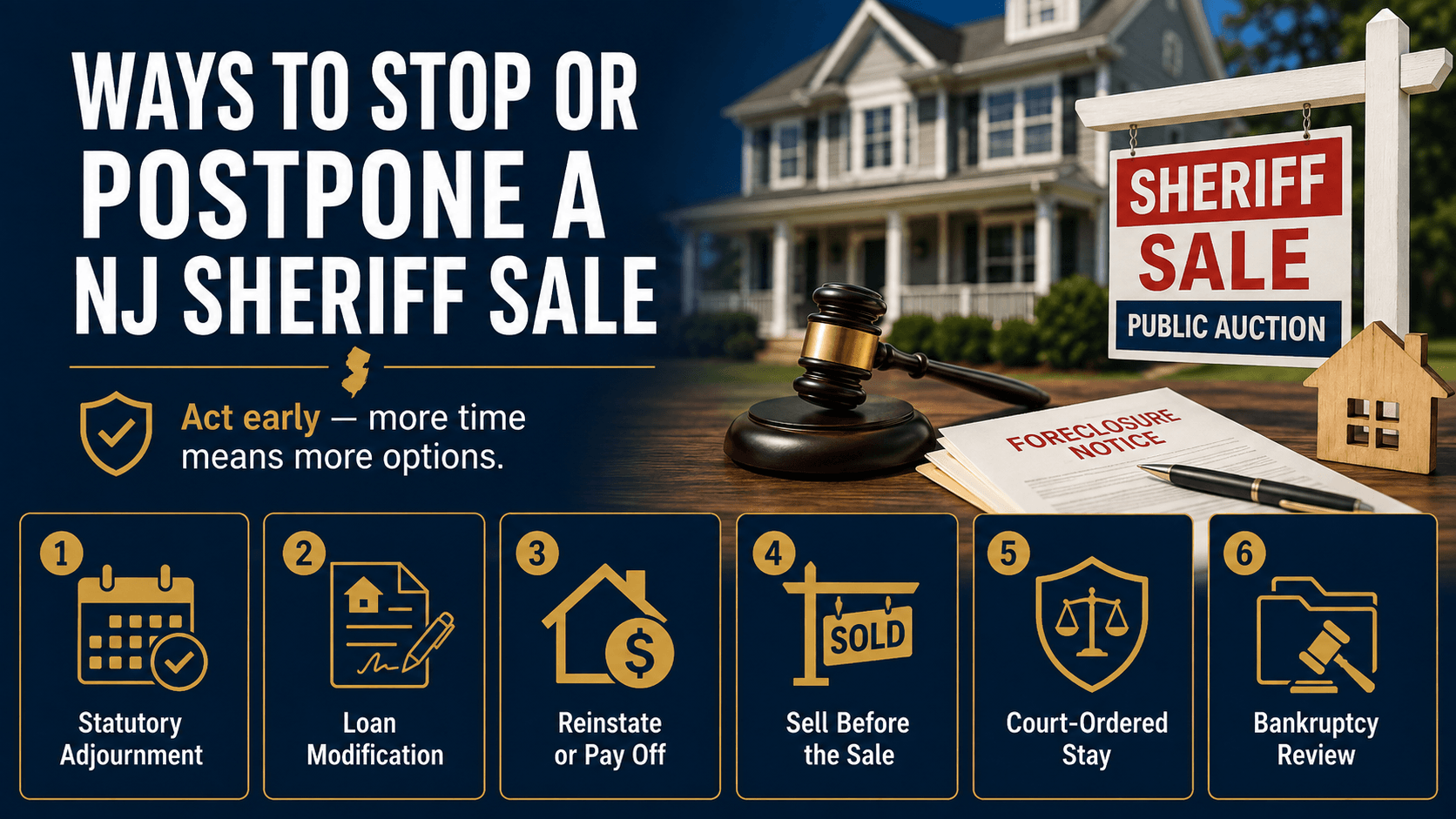
The most common possibilities include:
1. Request Your Statutory Sheriff Sale Adjournments
This is one of the most important New Jersey-specific rights for a homeowner facing an imminent sale.
Under N.J.S.A. 2A:17-36, a sheriff sale can have up to five statutory adjournments:
- Two requested by the lender
- Two requested by the debtor/homeowner
- One additional adjournment if both sides agree
Each statutory adjournment may be for up to 30 calendar days. A court can also order additional adjournments for cause.
See the New Jersey Legislature’s sheriff sale adjournment law.
How Many Times Can a Homeowner Postpone a Sheriff Sale in NJ?
A homeowner can request two statutory adjournments, each lasting up to 30 calendar days.
That potentially creates approximately 60 additional days, although the exact procedure for requesting the adjournment should be confirmed with the county sheriff’s office.
This time can be extremely valuable.
An adjournment does not eliminate the foreclosure. It moves the auction date.
The extra time may allow a homeowner to complete a property sale, obtain a payoff, finish a loss-mitigation review, consult an attorney or pursue another solution.
Important 2026 update: Some older online resources and even some county webpages still describe 28-day postponements. Current N.J.S.A. 2A:17-36 provides for adjournments of up to 30 calendar days.
https://www.youtube.com/watch?v=L3tkg-ZSGIA
2. Apply for a Loan Modification or Other Loss-Mitigation Option
If keeping the house is the priority, contact the mortgage servicer immediately and ask what loss-mitigation programs may be available.
Depending on the loan and circumstances, possibilities might include a modification, repayment arrangement or another foreclosure-avoidance option.
Timing matters enormously.
Under federal Regulation X, certain protections can apply when a mortgage servicer receives a complete loss-mitigation application more than 37 days before a scheduled foreclosure sale.
The CFPB warns that applications submitted 37 days or less before the sale do not necessarily receive the same procedural protections.
That does not mean you should give up if you are inside the 37-day window. Servicer or investor-specific requirements may still require consideration of certain options. It does mean you should act immediately rather than assume submitting an application automatically stops the auction.
For official information, see the Consumer Financial Protection Bureau’s mortgage loss-mitigation rules.
3. Reinstate or Pay Off the Mortgage
If sufficient funds are available, resolving the amount required by the lender may prevent the foreclosure from reaching sale.
The amount necessary will depend on the loan, judgment, interest, legal expenses and other charges.
Do not estimate this amount from an old mortgage statement.
Ask the lender, servicer or foreclosure attorney for the appropriate current figure and confirm any deadline for payment.
4. Sell the House Before the Sheriff Sale
For a homeowner with equity who no longer wants or cannot afford to keep the property, selling before the auction can be one of the most important options to investigate.
Can You Sell a House Before a Sheriff Sale in NJ?
Yes. A homeowner can generally sell a property while it is in foreclosure as long as the transaction can be completed and the debts and liens necessary to transfer title can be resolved before the sheriff sale occurs or the sale is otherwise postponed.
Foreclosure does not automatically eliminate the homeowner’s ownership the moment a complaint is filed.
But timing becomes progressively more difficult as the auction approaches.
If the property has enough equity, the closing proceeds can potentially be used to satisfy the mortgage and other amounts that must be paid.
If the mortgage and other required obligations exceed the property’s sale proceeds, a short sale may require the mortgage lender’s approval.
Why Selling Before the Auction Can Matter for Equity
A normal real estate sale gives the homeowner more control over:
- The buyer
- The purchase price
- The closing date
- Negotiations
- Access to the property
- How remaining equity is handled
A sheriff sale is an auction designed to satisfy debt, not a traditional retail marketing process designed around maximizing the homeowner’s net proceeds.
That does not mean every sheriff sale produces a bad price. It does mean homeowners with substantial equity should understand what is at stake before allowing the decision to be made at auction.
5. Ask the Court to Stay the Sheriff Sale
In some circumstances, a homeowner may ask the Superior Court to temporarily stop the sheriff sale.
This is different from requesting one of the statutory adjournments from the sheriff.
A court-ordered stay generally requires a legal basis and court approval.
Because the facts, required filings and timing can be highly case-specific, a homeowner considering emergent court relief should speak with a New Jersey foreclosure attorney rather than relying on an online template.
The New Jersey Courts foreclosure self-help resources provide official information for homeowners dealing with foreclosure.
6. Bankruptcy May Stop a Scheduled Sale in Some Circumstances
Filing a bankruptcy petition can trigger the federal automatic stay, which generally stops many collection activities, including foreclosure activity.
Chapter 13 bankruptcy can potentially allow an eligible homeowner with regular income to address mortgage arrears through a repayment plan.
But bankruptcy is not a simple foreclosure-delay strategy.
Previous bankruptcy filings, motions for relief from the automatic stay, the timing of the filing and the status of the foreclosure can all matter.
If the sheriff sale has already occurred, the analysis becomes even more complicated.
For official background, see the United States Courts’ Chapter 13 Bankruptcy Basics.
Anyone considering bankruptcy to stop an imminent sheriff sale should consult a qualified bankruptcy attorney immediately.
What Happens at a NJ Sheriff Sale?
At the auction, the property is offered to qualified bidders under the procedures established by New Jersey law and the applicable county sheriff.
One term homeowners frequently see is the upset price.
What Is the Upset Price at a NJ Sheriff Sale?
The upset price generally represents the amount associated with the foreclosing creditor’s judgment and permitted costs that influences the lender’s bidding position at the auction.
Recent New Jersey legislation has added requirements regarding disclosure and treatment of the upset price in residential foreclosure sales.
See the New Jersey Community Wealth Preservation Program legislation.
The lender does not normally need to arrive with a suitcase full of cash to bid against its own debt. It can generally use its credit position when bidding.
If a third-party bidder exceeds the lender’s position and satisfies the auction requirements, that bidder may purchase the property.
If nobody does, the plaintiff/lender can end up as the successful bidder.
What Happens If Nobody Bids on the House?
A sheriff sale does not necessarily fail just because no outside investor wants the property.
The foreclosing lender commonly bids based on the amount owed to it.
If no third party places a sufficient higher bid, the lender can become the successful bidder and ultimately take title to the property.
That property may later be marketed as lender-owned or REO — real-estate-owned property.
What Is New Jersey’s Community Wealth Preservation Program?
New Jersey made significant changes to residential sheriff-sale law through the Community Wealth Preservation Program, enacted through P.L. 2023, c.255.
Among other things, the law created special provisions intended to give certain eligible purchasers — including some foreclosed homeowners, next of kin and tenants — additional opportunities to purchase qualifying residential properties and potentially qualify for reduced deposit requirements.
For certain qualifying participants, the law provides a 3.5% deposit structure rather than the ordinary 20% deposit requirement, subject to statutory conditions and financing requirements.
Because parts of the program have been the subject of litigation and county implementation can change, anyone planning to bid using the Community Wealth Preservation Program should verify the current requirements with the applicable sheriff’s office.
The statute can be reviewed directly through the New Jersey Legislature’s Community Wealth Preservation Program law.

what happens after a sheriff sale
What Happens After a Sheriff Sale in NJ?
The auction is a major legal event, but there is still a short period afterward that homeowners need to understand.
Is There a Redemption Period After a Sheriff Sale in NJ?
Yes. New Jersey generally recognizes a 10-day redemption period after a sheriff sale.
During this period, a homeowner may have the ability to redeem the property by satisfying the required amount.
New Jersey’s court rules also establish a 10-day period for objections to the sheriff sale, with additional procedural language concerning objections before delivery of the conveyance.
Morris County’s current sheriff-sale instructions specifically identify the tenth day after the auction as the end of the defendant’s redemption period.
This is not a period to wait and see what happens.
If the auction already occurred and you believe you may have grounds to redeem the property, challenge the sale or protect another legal right, contact an attorney immediately.
Does the Buyer Own the House Immediately After the Auction?
Not in the same way that ownership changes hands at the instant someone makes the highest bid.
There are post-sale procedures, the redemption/objection period and eventually delivery of the sheriff’s deed.
Nevertheless, homeowners should not interpret that administrative gap as an unlimited opportunity to undo the sale.
The 10-day post-sale period is the critical timeframe to focus on.
How Long Can You Stay in Your House After a Sheriff Sale in NJ?
A sheriff sale does not normally mean the sheriff removes the occupants from the property at the auction itself.
After the purchaser obtains the right to possession, additional legal procedures are generally necessary.
The New Jersey Courts explain that after completion of the sheriff sale, the plaintiff can seek a Writ of Possession, which instructs the sheriff regarding removal of occupants.
See the New Jersey Courts Foreclosure FAQ.
That means the timeline between auction and physical removal can vary.
However, remaining in the property should not be confused with continuing to own it.
Homeowners should use this period to understand their legal status and prepare for what comes next.
What If the Property Has Tenants?
Tenants can have rights that are different from those of the former homeowner.
New Jersey’s landlord-tenant and anti-eviction laws may protect qualifying tenants even though ownership of the property has changed.
A homeowner, tenant and successful bidder therefore should not assume that everyone’s right to possession ends on the same date.
What Happens to Your Equity After a Sheriff Sale?
This is one of the most misunderstood parts of foreclosure.
A sheriff sale does not automatically mean that every dollar of a homeowner’s equity simply becomes the bank’s money.
Sale proceeds are applied according to the debts, liens, costs and priorities affecting the property.
If the auction generates more money than is required to satisfy those obligations, there can be surplus funds.
New Jersey describes surplus funds as money remaining after a foreclosure sale once the appropriate mortgage debt, taxes and other obligations are paid. Eligible former owners may be entitled to remaining surplus after superior claims are resolved.
See information from the New Jersey Attorney General regarding foreclosure surplus funds.
Example of Sheriff Sale Surplus Funds
Suppose a home sells at sheriff sale for:
$500,000
And assume, purely for illustration:
- Foreclosing mortgage and judgment: $300,000
- Other valid liens, costs and claims: $50,000
There could potentially be approximately:
$150,000 of surplus proceeds
The actual distribution would depend on lien priority, court procedures and other claims.
That is very different from saying the homeowner automatically receives $150,000.
But it is equally inaccurate to assume that all remaining equity automatically disappears.
Can You Claim Sheriff Sale Surplus Funds Yourself?
Homeowners should be cautious about companies contacting them after foreclosure and offering to “recover” money for large fees.
New Jersey has specifically warned consumers about foreclosure surplus-fund solicitations. Homeowners can investigate the process for claiming money to which they are entitled without automatically surrendering a large percentage to a third party.
See the New Jersey Attorney General’s consumer warning regarding foreclosure surplus funds.
Can You Lose Equity by Waiting for a Sheriff Sale?
Potentially, yes.
Even though legally available surplus proceeds can remain payable after the auction, the amount of surplus depends in part on the property’s sale price.
Consider two simplified outcomes.
Scenario A: Homeowner Sells Before the Auction
A home is worth approximately $500,000.
The total mortgage payoff, liens and transaction expenses equal $325,000.
A properly marketed sale near market value could potentially preserve a substantial portion of the difference for the homeowner.
Scenario B: Property Goes to Sheriff Sale
If the property produces a materially lower auction price, there may be considerably less money left after the liens and foreclosure-related costs are satisfied.
That is why a homeowner who has equity but does not intend to keep the house should evaluate a voluntary sale before the auction rather than assuming the foreclosure process will maximize the property’s value for them.
Foreclosure or Sheriff Sale? What Should You Do Right Now?
The amount of time remaining should influence your next move.
If You Just Received Foreclosure Papers
You generally have more options than someone whose auction is tomorrow.
Investigate:
- Whether keeping the house is financially realistic
- Loss mitigation or loan modification
- Whether the foreclosure should be contested
- The amount owed
- Property value and available equity
- Whether selling is the better financial decision
Do not wait for the sheriff-sale notice before determining what your house is worth.
If a Sheriff Sale Has Been Scheduled
Confirm three things immediately:
1. The exact sheriff sale date
Check directly with the sheriff’s office.
2. Whether you have used either of your two statutory adjournments
Each homeowner-requested adjournment can be up to 30 calendar days under current law.
3. What solution you are actually pursuing
Postponing a sheriff sale is useful only if the additional time helps you complete something:
- Close a sale
- Complete loss mitigation
- Obtain financing
- Resolve the mortgage
- Seek court relief
- Complete another legitimate foreclosure solution
Buying 30 days without a plan merely moves the deadline.
If Your Sheriff Sale Is Less Than 30 Days Away
Treat the situation as urgent.
If you intend to sell, determine immediately whether the home has enough equity and whether a buyer can realistically close before the auction.
If you intend to keep the property, speak with the mortgage servicer and appropriate legal professionals immediately about available options.
If you have not used your statutory adjournments, contact the applicable county sheriff’s office and determine the current procedure for requesting one.
If the Sheriff Sale Is Tomorrow
Do not assume nothing can be done.
But do not rely on an internet article promising that a particular strategy will automatically stop the sale either.
Immediately investigate:
- Whether an unused statutory adjournment remains
- Whether the lender has agreed to postpone the sale
- Whether there is a legitimate basis for emergent court relief
- Whether bankruptcy is appropriate after consultation with counsel
- Whether another transaction or payoff is actually ready to close
At this stage, minutes and documentation can matter.
If the Sheriff Sale Already Happened
This is an entirely different category.
The focus should immediately shift to:
- The 10-day redemption period
- Possible objections to the sale
- Whether immediate legal review is required
- What happens to possession
- Whether surplus funds may eventually exist
Do not assume you still have months because the deed has not arrived.
Where Can You Find Your NJ Sheriff Sale Date?
Sheriff sales are administered at the county level.
Homeowners should look for the official sheriff-sale or foreclosure-sale page for the county where the property is located.
County procedures can differ regarding:
- Sale dates
- Auction locations
- Online versus in-person procedures
- Adjournment requests
- Registration
- Accepted payment methods
- Community Wealth Preservation Program procedures
Always favor the official county sheriff’s website over a third-party auction aggregator when confirming whether your home is scheduled for sale.
Is a NJ Sheriff Sale the Same as a Tax Sale?
No.
A traditional municipal tax sale and a mortgage foreclosure sheriff sale are different legal processes.
New Jersey municipalities can sell tax sale certificates associated with delinquent property taxes or municipal charges.
A mortgage foreclosure sheriff sale generally occurs after a mortgage lender completes the judicial foreclosure process and obtains authority to sell the real estate.
Because both involve delinquent property obligations and the word “sale,” they are frequently confused online.
A homeowner facing a tax certificate foreclosure should determine exactly which legal process is occurring before relying on advice about mortgage sheriff sales.
Common Mistakes Homeowners Make Before a Sheriff Sale
Waiting Because You Think the Bank Will Postpone It
Never assume an auction is being postponed until the change is confirmed.
Assuming a Loan-Modification Application Automatically Stops the Sale
It may not.
Federal protections depend heavily on timing and whether the application is complete. The more-than-37-day threshold can be particularly important.
Using Both Adjournments Without a Plan
Two 30-day postponements can be incredibly valuable.
Use the time deliberately.
Not Knowing What the House Is Worth
A homeowner may spend months trying to save an unaffordable property without realizing there is significant equity that could be protected through a sale.
Or the homeowner may assume there is equity when liens and the mortgage balance actually consume most of the property’s value.
Get the numbers.
Believing Foreclosure Means the Bank Already Owns the House
A foreclosure complaint and a completed sheriff sale are not the same event.
Knowing where you are in the process determines what options remain.
Assuming All Equity Disappears at Auction
Surplus funds can exist after a foreclosure sale.
The bigger concern is losing control over how the property is marketed and what price it ultimately generates.
NJ Sheriff Sale FAQ
What is a sheriff sale in New Jersey?
A sheriff sale is a public auction of real estate conducted pursuant to a court-authorized foreclosure. It generally occurs after a mortgage lender obtains final judgment and a writ of execution.
How does a sheriff sale work in NJ?
After final judgment, a writ of execution is sent to the county sheriff. The sale is scheduled and publicly advertised, bidders are permitted to compete for the property, and the successful bidder can ultimately receive a sheriff’s deed after the required post-sale procedures.
How long does the sheriff have to schedule a foreclosure sale in NJ?
The New Jersey Courts currently state that the sheriff has 150 days from receipt of the writ of execution to auction the property.
How many times can I postpone a sheriff sale in NJ?
A debtor/homeowner may request two statutory adjournments. The lender may request two, and another adjournment may occur by agreement of both sides. Each statutory adjournment can be for up to 30 calendar days.
Are NJ sheriff sale postponements 28 days or 30 days?
Current N.J.S.A. 2A:17-36 provides for statutory adjournments of up to 30 calendar days each. Some older online material still references 28 days.
Can I sell my house before a sheriff sale in New Jersey?
Generally, yes. The transaction must be completed in time to resolve the mortgage and other obligations necessary to transfer the property, or the sheriff sale must otherwise be postponed. If the property is worth less than the required payoff, lender approval of a short sale may be necessary.
Will putting my house on the market stop the sheriff sale?
No. Simply listing the property does not automatically stop a sheriff sale. The homeowner needs enough time to complete the transaction or needs a valid postponement or stay of the auction.
Can a loan modification stop a sheriff sale?
Potentially. Timing and the status of the application matter. Federal mortgage-servicing protections can become particularly important when a servicer receives a complete loss-mitigation application more than 37 days before the scheduled foreclosure sale.
Will filing bankruptcy stop a sheriff sale?
A bankruptcy filing can trigger an automatic stay that generally stops foreclosure activity, but exceptions and limitations apply. Prior filings, court orders and the timing of the sheriff sale can materially change the analysis. Speak with a qualified bankruptcy attorney before relying on bankruptcy to stop an auction.
Is there a redemption period after a NJ sheriff sale?
New Jersey generally provides a 10-day redemption period following a sheriff sale. Objections to the auction also involve an important 10-day post-sale period.
Can I stay in my house after the sheriff sale?
The occupants are not normally physically removed at the auction. Additional legal procedures, including a Writ of Possession, can be necessary before removal.
What happens if nobody bids at a sheriff sale?
The foreclosing lender can generally bid based on its judgment. If an outside bidder does not submit a sufficient higher bid, the lender may become the successful bidder and ultimately take ownership.
What happens to my equity after a sheriff sale?
Sale proceeds are used to satisfy the applicable mortgage debt, liens, costs and other claims in their proper priority. If money remains afterward, there can be surplus funds to which the former homeowner may be entitled.
How do I claim surplus money from a NJ sheriff sale?
Surplus funds may ultimately be handled through the New Jersey court system after superior liens and claims are addressed. Homeowners should verify the official process before paying a third-party surplus-recovery company a large fee.
What should I do if my NJ sheriff sale is less than a week away?
Confirm the auction date directly with the county sheriff, determine whether you have unused statutory adjournments, contact your mortgage servicer and immediately investigate any sale, payoff, legal, loss-mitigation or bankruptcy option you are seriously considering.
What should I do if my house was sold at sheriff sale yesterday?
Treat the situation as an emergency. New Jersey’s 10-day post-sale period can affect redemption and objections. Contact an appropriate New Jersey attorney immediately rather than waiting for the deed or an eviction notice.
The Bottom Line: The Earlier You Act, the More Options You Usually Have
A New Jersey sheriff sale is not the beginning of foreclosure.
It is near the end.
That distinction is critical.
A homeowner who acts when the first foreclosure notices arrive may have months to investigate a loan modification, challenge the foreclosure, sell the property, refinance, negotiate with the lender or develop another plan.
A homeowner who acts several weeks before a sheriff sale still has options, but the clock is much shorter.
A homeowner whose auction is tomorrow may be dealing with statutory adjournments, emergency legal remedies and decisions that must be made immediately.
And once the property has been sold, the discussion changes again because New Jersey’s short post-sale redemption and objection period becomes critically important.
If your goal is to keep the house, determine what realistic foreclosure-avoidance options remain.
If keeping the house is no longer financially realistic and you have equity, determine what the property is worth and what you would actually net from a sale before allowing the auction to make that decision for you.
The most expensive mistake is often not choosing the “wrong” option.
It is waiting until there are almost no options left.
Primary Sources and Further Reading
- New Jersey Courts — Foreclosure Self-Help
- New Jersey Legislature — Sheriff Sale Adjournment Law, P.L. 2019 c.71
- New Jersey Legislature — Community Wealth Preservation Program, P.L. 2023 c.255
- Consumer Financial Protection Bureau — Mortgage Loss-Mitigation Procedures
- United States Courts — Chapter 13 Bankruptcy Basics
