
NJ Property Tax Records & MODIV/SR1A Explained: Where Did the Data Go, and How to Find It Now (2025 Guide)
If you’ve recently tried to look up a New Jersey property tax records on the NJACTB website and got a dead end – you’re not alone. A portal that real estate investors, attorneys, journalists, and homeowners relied on for years simply stopped working in early 2023. No announcement. No redirect. Just gone.
The reason is Daniel’s Law, a New Jersey privacy statute that dramatically changed how property records can be shared publicly. But here’s what most people don’t know: the data itself never went anywhere. The NJ property tax records you’re looking for – assessed values, ownership history, sales data, liens – are still fully public. They’re just accessed differently now.
In this guide, we break down exactly what happened, explain the MODIV and SR1A databases that power NJ property tax records, and show you step by step where to find the information you need today. Whether you’re a homeowner checking your assessment, a real estate investor researching a deal, or simply trying to understand what’s going on – this is the most complete explanation you’ll find anywhere.
What’s In This Guide
- What is MODIV? New Jersey’s Property Tax Database Explained
- What is SR1A? Understanding NJ Property Sales Data
- What Was the NJACTB Portal – and Why Did It Disappear?
- Daniel’s Law: What It Is, What Changed, and the 2023 Litigation Explosion
- Is NJ Property Tax Data Still Public? (Yes – Here’s Where)
- Complete Resource Guide: Where to Search NJ Property Records Today
- Why This Matters for NJ Real Estate Investors
- How We Can Help If You’re Dealing With a Difficult Property Situation
What Is MODIV? New Jersey’s Property Tax Assessment Database Explained
MODIV – short for Modification IV – is the official statewide property tax assessment system used across all 21 counties of New Jersey. Every parcel of real property in the state is tracked in this database: residential homes, commercial buildings, vacant lots, condominiums, mobile homes, and more.
The New Jersey Division of Taxation’s County Tax Board Handbook describes the system’s scope clearly: MODIV maintains and updates all assessment records and produces all statutorily required tax lists for property tax bills, accounting for every parcel of real property as identified on each municipality’s official Tax Map, along with taxable values and descriptive data.
In practical terms, MODIV is the engine behind almost everything you’d want to know about a property in New Jersey. When you pull up an assessed value, check who owns a parcel, or research whether a property has had a recent revaluation, you’re tapping into data that flows through MODIV.
What Information Does MODIV Contain?
- Property owner name and mailing address
- Block and lot number (the unique identifier for every NJ parcel)
- Land and improvement assessed values
- Property class (residential, commercial, farm, exempt, etc.)
- Year built and building characteristics
- Deed book and page number
- Date of last sale
- Tax deductions and exemptions (senior, veteran, disabled)
- Added and omitted assessments
Who Manages MODIV? BRT Technologies and Microsystems
MODIV is not managed by a single state agency but rather by two private vendors under contract with individual municipalities and counties across New Jersey: BRT Technologies and Microsystems . These companies provide the software that municipal tax assessors use to maintain and update records on a daily basis.
The distinction between the two vendors matters for where you search today. Municipalities using BRT Technologies typically have their public-facing data accessible through taxdatahub.com, while Microsystems-managed counties often have their own county portals. More on that in the resource guide below.
How Does the Data Flow?
New Jersey’s property tax handbook describes the data submission cycle: the MODIV Master File is sent to the Division of Taxation with a hard copy of the Tax List Summary and Table of Aggregates every February 1st. A second submission follows after tax billing is complete. This means the state always has a current snapshot of every assessed parcel statewide – the question is just how you access it.
What Is SR1A? Understanding NJ Property Sales Data
If MODIV is the assessment layer – what a property is worth for tax purposes – then SR1A is the sales layer. Every time a deed is recorded in New Jersey, the municipal tax assessor processes an SR1A form that captures the sale price, date of sale, and buyer/seller information.
The NJ Division of Taxation uses SR1A data for a critical function: the Director’s Table of Equalized Valuations. This table determines how much each municipality’s assessments reflect true market values – a process called equalization. It directly affects how state school aid is distributed and how county budgets are apportioned.
For real estate investors, SR1A data is gold. It tells you what properties actually sold for, not just what they’re assessed at. This lets you quickly calculate the assessment-to-sales ratio for any area and identify properties where the assessment may be significantly out of line with market value – a potential opportunity for a tax appeal or a motivated seller conversation.
What Does SR1A Data Tell You?
- Sale price and date of every recorded deed transaction
- Whether the sale was arm’s length (usable for equalization) or a non-usable transfer (estate sale, foreclosure, family transfer, etc.)
- Buyer and seller names
- Property classification at time of sale
- Assessment at time of sale
- Calculated sales ratio (assessment divided by sale price)
Where to Find SR1A Data
The NJ Division of Taxation publishes annual SR1A files available for free download going back to 2020 at nj.gov/treasury/taxation. These are flat data files (typically in spreadsheet format) that contain every recorded sale statewide for a given year. County-level SR1A data is also searchable through many of the county portals listed in our resource guide below.
What Was the NJACTB Portal – and Why Did It Disappear?
For years, the New Jersey Association of County Tax Boards (NJACTB) operated a centralized, free, public-facing portal that let anyone search MODIV and SR1A data for nearly every county in New Jersey – all in one place. It was one of the most useful tools available for NJ property research, and real estate investors, title searchers, journalists, attorneys, and homeowners relied on it heavily.
The NJACTB is described in the NJ Division of Taxation’s official County Tax Board Handbook as the body that meets monthly to address real property tax and assessment issues throughout New Jersey, sponsoring education and professional enrichment programs for tax board professionals across the state. The centralized data portal was an extension of that mission – making the public tax list accessible to the public.
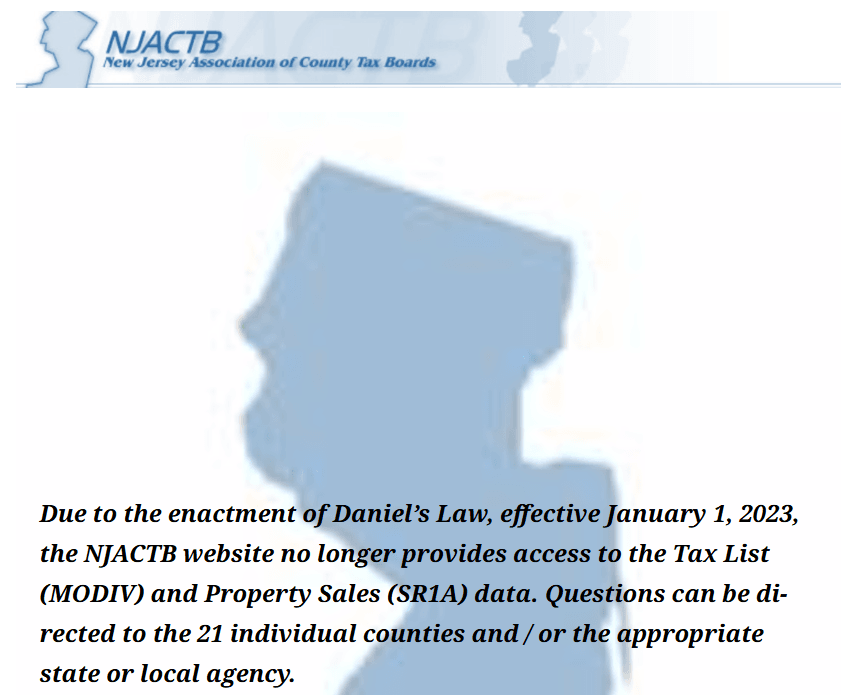
“Due to the enactment of Daniel’s Law, effective January 1, 2023, the NJACTB website no longer provides access to the Tax List (MODIV) and Property Sales (SR1A) data.” – NJACTB official website (njactb.org)
The impact was immediate and felt across the industry. As one NJ news outlet noted, the NJACTB website once made it easy to locate assessed property values as reported by local assessors and tax bills, as well as owner information – information useful to journalists, the public, and real estate professionals.
The NJACTB did not shut down its education and governance functions – it still operates as an association of county tax boards. It simply could no longer host the centralized public search interface without running afoul of Daniel’s Law compliance requirements.
Daniel’s Law: What It Is, What Changed, and Why It Matters for Property Records
The Origin: A Tragedy That Changed NJ Law
Daniel’s Law takes its name from Daniel Anderl, the 20-year-old son of Federal Court Judge Esther Salas. In July 2020, a disgruntled litigant used personal information found online to locate Judge Salas’s home address and showed up disguised as a delivery person. Daniel answered the door and was killed. His father was critically injured. The intended target, Judge Salas, was unharmed.
In the wake of the attack, Governor Murphy signed Daniel’s Law (P.L. 2020, c.125), which prohibits the disclosure of home addresses and phone numbers of judges, prosecutors, law enforcement officers, and their immediate family members. The law was subsequently amended in 2021 with further clarifications, and compliance was required statewide beginning January 13, 2023.
Why Property Records Were Affected
The connection to property records is direct: MODIV and SR1A data include owner names and property addresses. For most property owners, this is completely fine to publish publicly – it always has been, and the NJ Division of Taxation’s own handbook explicitly states that the tax list is a public record.
The problem is that some of those property owners are judges, prosecutors, or law enforcement officers – covered persons under Daniel’s Law. Publishing their home address in a publicly accessible database, even a legitimate public records database, became legally risky for organizations operating those databases.
“This seems like a good idea in theory, but in practice it was not well thought out nor well implemented especially in the beginning. Literally dozens of existing laws require parties as well as public entities themselves to rely on public information regarding property ownership.” – NJ Attorney Peter Cecinini, Cecinini Law (2023)
Rather than try to selectively redact covered persons from a database containing millions of records – a technically and legally complex undertaking – many operators of public-facing property databases simply shut down their portals entirely. That is what NJACTB did. Some counties went further: Gloucester County removed all online access to county land records beginning April 1, 2023, and Mercer County restricted its property information portal to credentialed professionals only.
The 2023 Amendments and the Litigation Explosion
The original 2022-era Daniel’s Law compliance requirements were disruptive but manageable for most public records operators. Then came the 2023 amendments – and everything changed.
The 2023 amendments allowed covered persons (judges, prosecutors, law enforcement) to assign their legal claims under Daniel’s Law to third parties. Almost immediately, a company called Atlas Data Privacy Corp. emerged as the dominant enforcer, acting as assignee for nearly 20,000 covered persons and sending blast email take-down notices to over 130 businesses between Christmas 2023 and New Year’s 2024. After a 10-day compliance window, Atlas filed lawsuits seeking approximately $20 million in statutory damages.
“The 2023 amendments to Daniel’s Law were promoted as a way to strengthen the protection of more public safety officials’ information, but the opposite occurred. Because the law now does not require those making the request to provide basic information to verify it, it’s harder for businesses to figure out if a request that comes in is legitimate and whether they are removing the right person’s information.”
– John Molinelli, former Bergen County Prosecutor and Daniel’s Law covered person (NJBIA, 2025)
As of early 2026, the NJ Supreme Court has heard arguments on the fundamental question of whether Daniel’s Law imposes strict liability – meaning a business can be sued regardless of whether it acted in good faith – or requires proof of negligence. The outcome of that case will shape how property records are managed in New Jersey for years to come.
Separately, NJ legislators introduced amendments in late 2025 that would remove the third-party assignment mechanism, which critics argue created, in the words of one sponsor, a ‘cottage industry’ for outside firms to profit off the law rather than actually protect covered persons.

Is NJ Property Tax Data Still Public? Yes – Here’s the Truth
Despite all of the above, New Jersey property tax records remain public records. The NJ Division of Taxation’s County Tax Board Handbook is unambiguous on this point – the tax list is a public record. Daniel’s Law did not change that fundamental status. What it changed is how certain data can be presented in centralized, publicly searchable online databases.
Owner names may be partially redacted on some platforms for properties owned by covered persons. But assessed values, block and lot numbers, property classifications, sale prices, deed dates, and tax information remain fully accessible. For the vast majority of property research – especially the kind NJ real estate investors do – the data you need is still out there.
✅ What You Can Still Find in NJ Property Records
- Assessed land and improvement values for any parcel
- Property class (residential, commercial, vacant, etc.)
- Block and lot / qualifier numbers
- Historical sale prices and dates (SR1A data)
- Assessment-to-sales ratios by municipalityTax rates by municipality
- Added and omitted assessments
- Deed book and page references
- Revaluation and reassessment history
- Tax deduction and exemption status
Where to Search NJ Property Tax Records Today: Complete Resource Guide
1. taxdatahub.com – The Primary BRT Technologies Interface
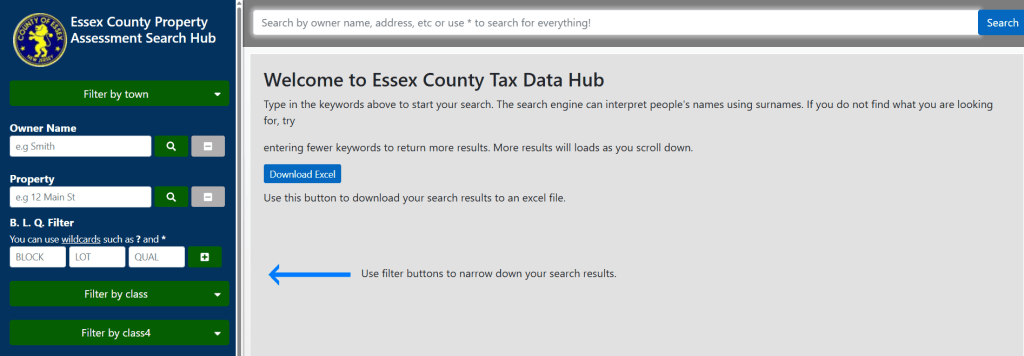
For many NJ counties, taxdatahub.com is the closest replacement for what the NJACTB portal offered. Managed by BRT Technologies (one of the two primary MODIV vendors), the site provides county-level MODIV property assessment searches including owner information, assessed values, sales history, and block/lot lookups. Confirmed active county pages include Atlantic, Essex, Camden, Passaic, Middlesex, and others.
- Search by: owner name, property address, or block/lot/qualifier
- Data includes: assessed value, property class, sales history (SR1A), deed info
- Access: free, public-facing
2. NJ Division of Taxation – Official State Downloads
The NJ Division of Taxation at nj.gov/treasury/taxation publishes downloadable MODIV property assessment files and SR1A sales files for every year going back to 2015 for assessments and 2020 for sales data. These are flat data files best suited for investors or researchers who want to analyze data in bulk rather than search individual parcels.
- Annual MODIV assessment files by year (2015 to present)
- Annual SR1A sales files by year (2020 to present), plus a current year-to-date file
- Note: owner names redacted per Daniel’s Law on statewide download files
3. NJ GIN Parcel Viewer – State Geographic Information Network
The NJ Geographic Information Network hosts an interactive statewide parcel map that overlays MODIV assessment data on aerial imagery. This is particularly useful for visually identifying properties, checking boundaries, and cross-referencing parcel data with geographic features. Note that owner names are redacted here per Daniel’s Law.
- Interactive map interface with property data on click
- Downloadable statewide parcel + MODIV composite (approx. 400MB)
- Updated annually with most recent tax year data
- search ‘NJ parcel viewer’
4. Rutgers MOD-IV Historical Database
If you need historical property data going back decades, the Rutgers MOD-IV Historical Database Portal is an invaluable resource. It contains over 30 years of NJ real estate parcel data maintained by municipal assessors, available for download for research and analysis purposes.
- 30+ years of historical MODIV parcel data
- Downloadable for research and analysis
5. NJ.gov Property Tax Transparency Portal
The State of New Jersey’s YourMoney.NJ.Gov portal includes a property tax search tool that covers all NJ parcels, showing location, owner info, block/lot, annual assessed value, prior year taxes, and property classification. It’s basic but state-official and always current.
6. NJParcels.com – Comprehensive Free Search
NJParcels.com is a popular free third-party aggregator that pulls from official sources and provides tax parcel, assessment, and sales information for all 3+ million property records in New Jersey. It also links parcel and GIS data in an easy-to-use format and includes a mobile-friendly interface.
- Free, public access
- Covers all 564 NJ municipalities across 21 counties
- GPS-enabled mobile search
7. County Tax Board Portals (Microsystems Counties)
Counties using Microsystems as their MODIV vendor often maintain their own county-specific portals accessible via msnj.us/[county]. Bergen County, Burlington County, Monmouth County, and others have dedicated portals. Hudson County directs users to taxrecords-nj.com.
- Bergen County: msnj.us/bergen
- Burlington County: msnj.us/burlington
- Monmouth County: msnj.us/monmouth or oprs.co.monmouth.nj.us
- Hudson County / Jersey City: taxrecords-nj.com
- Morris County: mcweb1.co.morris.nj.us/MCTaxBoard/SearchTaxRecords.aspx
| Resource | URL | Best For |
| taxdatahub.com | taxdatahub.com | BRT county MODIV lookups |
| NJ Division of Taxation | nj.gov/treasury/taxation | Bulk data downloads |
| NJ GIN Parcel Viewer | njgin.nj.gov | Map-based searches |
| Rutgers Historical DB | modiv.rutgers.edu | 30+ years historical data |
| NJ.gov Transparency | nj.gov/transparency/property | Quick state-official lookups |
| NJParcels.com | njparcels.com | Free comprehensive search |
| County portals (MSNJ) | msnj.us/[county] | Microsystems county data |
Why NJ Property Tax Records Matter for Real Estate Investors

For NJ real estate investors, MODIV and SR1A data aren’t just useful – they’re essential. Here’s how the data gets used in practice:
Researching a Potential Deal
Before making an offer on any NJ property, an experienced investor pulls the MODIV record to check the assessed value, when the property was last sold and for how much, whether there are any deductions or exemptions in place, and the property class. This takes less than five minutes and can tell you a great deal about whether the numbers work.
Identifying Tax Liens and Delinquencies
MODIV data can flag properties with outstanding tax issues, which is relevant both for due diligence and for identifying motivated sellers. A property owner who is significantly behind on taxes is often in a difficult position – and may be exactly the kind of homeowner we can help.
Understanding Assessment vs. Market Value
New Jersey law requires properties to be assessed at 100% of true market value, but the reality is that many municipalities have assessment-to-sales ratios well below that. The SR1A data and the Director’s Table of Equalized Valuations tell you the actual ratio for any municipality – critical context for evaluating whether an assessed value is an accurate reflection of what a property would sell for.
Verifying Ownership for Outreach
Investors who do direct mail or direct outreach to property owners need accurate ownership data. MODIV is the most authoritative source for this in New Jersey – more current than county deed records in many cases, since assessors process SR1A forms shortly after each deed is recorded.
Supporting a Tax Appeal
If you’ve recently purchased a property in NJ and believe the assessed value doesn’t reflect what you paid, SR1A sales data for comparable properties is a critical piece of your appeal. The assessment-to-sales ratio for your municipality tells you how far off your assessment may be and whether an appeal is worth pursuing.
Dealing With a Difficult Property Situation in NJ? We Can Help.
Property tax records are often the starting point for understanding a difficult property situation – but knowing what the data says and knowing what to do about it are two different things. At I Will Buy Your House For Cash, we’ve worked with New Jersey homeowners facing all kinds of challenging situations that show up in the public record:
- Tax liens and delinquent property taxes
- Inherited properties with complicated ownership histories
- Foreclosure or pre-foreclosure situations
- Properties with title issues, code violations, or outstanding judgments
- Homes that need significant repairs or are in distressed condition
- Situations where you simply need to sell quickly and move on
We buy houses in New Jersey in any condition, on your timeline, with no commissions, no repairs, and no hassle. We’re a family-run operation based in Cranford, NJ – and we’ve helped homeowners across all 21 counties navigate some of the most complex real estate situations in the state.
If you’re sitting on a property and not sure what to do next, request a free, no-obligation cash offer. It costs nothing and there’s no pressure – just a straight answer about what we can offer and how we can help.

Sources & Further Reading
- Daniel’s Law FAQs
- NJBIA: Recent Changes to Daniel’s Law Create Major Risks for NJ Businesses (June 2025)
- NJ Monitor: NJ Supreme Court Hears Daniel’s Law Arguments (March 2026)
- Cecinini Law: What is Daniel’s Law and Why Has It Created Confusion (August 2023)
